Hi, everyone!
I am often approached by colleagues from all over the world asking for access to my papers. Today, I am happy to announce that almost all of my articles in English are now downloadable from the Bibliography section of this website. I hope you enjoy reading them and would appreciate hearing any and all feedback you may have.
My very best to all of you,
Sachiko
A workshop on Mister O Corpus was held on March 26-28, 2013 at the International House of Japan Women's University, Tokyo, Japan.
The project on Emancipatory Pragmatics obtained Thai video discourse data, termed Mister O Corpus, in February 2012. The data were transcribed and translated by graduate students at Thammasat University and Chulalongkorn University in Thailand. The purpose of the workshop was to discuss analyzed data of the Thai version of Mister O Corpus as compared to other languages. There were three presentations by Thai scholars. We also had 10 presentations by Japanese and one presentation from Korea. The workshop turned out quite successfully due to its congenial and friendly atmosphere. Even though our communicative medium was English, I felt an 'Asian air' that I believe gave comfort to the participants. This may be because of how silence was used in interactions.
Here is the program for the event:
Saeko Machi
Repeating for rapport in conversation: Introducing the organic relation of Japanese repetition, grammar, and the concept of self
[Power Point Slides PDF](299KB)
Kaori Kobayashi
How Do Listeners Participate in Conversation? A Study of Backchannels in Japanese and English
[Power Point Slides PDF](550KB)
Kie Kudo
Topic Shifts in English and Japanese Conversation
Kishiko Ueno
Social Indexcality of Question-Asking in Teacher-Student Conversation
Yuko Nomura
Differences of narrating thoughts and emotions of the characters in English and Japanese narratives
Satomi Kawasoe
The Narrator's Viewpoint in Japanese and English: Fluidity and Consistency
Yoko Fujii
Differences of interactional styles between Japanese and English
[Power Point Slides PDF](954KB)
Sachiko Ide
How can we explain the differences between Japanese and English?
[Power Point Slides PDF](1MB)
Myung-Hee Kim
Negotiating Disagreement in conversation: Interaction between Language and Culture
Miyabi Ozawa
A Comparative Study of Occurrence and Non-Occurrence of Subject in Japanese and English from the Perspectives of Syntax, Discourse Pragmatics and Culture
[Power Point Slides PDF](149KB)
Kuniyoshi Kataoka
A cross-linguistic analysis of eye gaze in a problem-solving task: A case of Japanese and American English
Natthaporn Panpothong & Siriporn Phakdeephasook
Forming a duet: Thai ways of co-constructing a story in task-based interactions
[Power Point Slides PDF](4.5MB)
Songthama Intachakra
Understanding Thai honorifics via Japanese concepts
[Power Point Slides PDF](6.2MB)
Woraporn Chamnansilp, Wikanda Kiatmanoch, Apinya Hantrakul
Some Pragmatic Phenomena in the Thai Mr O Corpus data: proposing ideas and the uses of laughter
[Power Point Slides PDF](632KB)
Yasuhiro Katagiri
Discussing Mister O Corpus data in Japanese, American English, Libyan Arabic and Thai
Workshops on Emancipatory Pragmatics have been held since 2007 in Tokyo, Japan and Sebha, Libya in our effort to let the academic wind blow multi-directionally. We held our most recent workshop from January 3rd to January 5th and it was hosted by Bill Hanks, Professor of Linguistic Anthropology at the University of California, Berkeley. It was a truly inspiring and exciting workshop with a congenial atmosphere. The topics discussed around the theme of Emancipatory Pragmatics were varied and intellectually stimulating. Topics presented included:
- 'The Pragmatics of Listening: The Constitution of Listening Genres in Buenos Aires, Argentina' by Xochitl Marsilli-Vargas
- 'Language Emergence as Condensation in the Seattle Deaf-Blind Community' by Terra Edwards
- 'Identity Conception and Authority Dependence in Consensus-Building Interactions' by Yasuhiro Katagiri
- 'Communication Technologies and the Practice of Oyakoko ('filial piety') in Japanese Families' by Chiho Sunakawa
- 'Transformation of Multimodal Sings into Narrative: A Case Study of a Japanese TV Commercial' by Kuniyoshi Kataoka
- 'Emancipatory Pragmatics and Knowledge Circulation' by Jacob Mey
- 'Emancipatory Pragmatics for an Ecology of the Global Public Sphere' by Jef Verschueren
- 'The Fragility of Sense-Making: Scalar, Social, and Ethical Dimensions of Local
Sign in Nepal' by Mara E. Green
- and 'Going Against the Tide?, Status Honorifics and the Logic of ba in Thai' by Songthama Intachakra.
My contribution was titled, 'Rethinking Linguistic Politeness from the Perspective of Ba/Field Theory.' Three presentations explicitly discussed the logic of ba as the explanatory frame for their discourse phenomena.
Clearly, there was much interest in the logic of ba and the extensive discussions on the subject continued through the end workshop and into the following dinner. It was Jef and Xochitl who discussed the difference between the concept of 'ba' and 'field' a la P. Bourdieu and concluded that the term ba should be introduced into English just as wakimae was. While in the former, a person (a self, an ego, or an actor) is considered as an element embedded in the space ('ba'), in the latter, the person is in control of the space ('field'). In other words, 'ba' is perceived subjectively whereas 'field' is recognized objectively.
(Reference: Epilogue to the 25th Anniversary Edition: A Dialogue on the Ideas of "World" and "Field" by Howard S. Becker and Alain Pessin, In Howard S. Becker Art Worlds: 25th Anniversary Edition Updated and Expanded, Berkeley: University of California Press, 2008.)
Below are the abstract and the power point slides of my presentation.
During my stay in Berkeley I was fortunate enough to be the houseguest of Robin, Susan Ervin-Tripp, and Chuck Fillmore. It was a gracious experience to spend time together with these exceptional personalities and minds. Susan served as IPrA President for six years prior to my appointment and contributed to IPrA's growth. Chuck was delighted that our new president is Jan-Ola, his former graduate student. I realize that our secretary general Jef Verschueren was also a graduate student at UC Berkeley. Robin, Susan and Chuck must be acknowledged for having laid the foundation of IPrA during the time they were teaching. To me, they are the forefather and mothers of our IPrA.
On May 4, 2012, RobinFest, a conference honoring Robin Lakoff's retirement, was held at Berkeley, California. Deborah Tannen and Mary Bucholtz, former students of Robin, organized this wonderful event. Participants expressed great admiration for Robin, whose thoughts and encouragement laid the ground for many of their careers. Her son Andrew Lakoff, for whom the monumental book Language and Woman's Place was dedicated, made a charming speech. He quoted the book's first page, in which he is referenced, "'For Andy whose generation will, I hope, have transcended these issues by the time he can read this book. 'I was five years old, then.''' It was in this moment that I believe all of the participants, including myself, realized that doing pragmatics (in this case, studies on woman's language) enables us to change the world.
George Lakoff also came to celebrate the event and made a warm speech. He mentioned that Robin, when studying classic Latin as an undergraduate, was already thinking 'pragmatics' when there was no word for it. Additionally, he also said that both of the authors of textbooks on pragmatics are students of Robin--that is, Stephen Levinson and Georgia Green. This remark reminded us that it was Robin's inspiration that opened the door for us to follow her and flourish in the field of pragmatics.
I am delighted to say that IPrA has kindly allowed me to keep my website hosted on its server. This is a wonderful opportunity to continue contact with my friends from around the world. During my presidency, many people contacted me expressing interest in IPrA. Some wanted some information or advice and others wanted to discuss academic matters, including my Presidential Lecture on the theory of 'ba.'
Over the past few years, people in countries such as Morocco, Libya, Indonesia, Malaysia, Iran and Pakistan have approached me. Our understanding of these primarily Islamic cultures is unfortunately somewhat poor. The people who have contacted me are interested in the IPrA but may not have had the opportunity to attend the bi-annual IPrAI conferences. Therefore, I am delighted to be communicating with them through my website.
In light of the vision of this association, it is essential that we let the wind blow multi-directionally from all parts of the world in order to improve our understanding of all people on Earth. I am pleased that our new President Jan-Ola expressed his intention to continue multi-directional dialogue in his first message as President.
I shall be waiting to hear from you on this website. I look forward to reading your messages with all my heart and I am sure we can achieve a wonderful dialogue together.
My term as president ended at the end of December 2011 and the new president, Dr. Jan-Ola Östman, will serve from 2012 to 2017. He has been the heart of IPrA since its inception. A gentleman with a great smile, I am sure he will make a wonderful president. I look forward to seeing IPrA flourish under his care in the next six years.
I hope to continue communicating with my dear IPrA friends and colleagues through this website!
I am very happy to report that the 12th International Pragmatics Conference was a great success. The conference was well attended, with more than a thousand registered participants. There were 17 parallel sessions and a poster session, but fortunately all events were held in one building called University Place at the University of Manchester. Everybody who attended must have had a stimulating and enjoyable time meeting old friends and renewing friendships.
As I promised, I am uploading Presidential Lecture on this Website for those who could not make it to the lecture on Sunday, July 3. I hope you will enjoy the video clips of the presentation. It consists of the text of the lecture and the PowerPoint slides.
Here it is: [PresLec_IPrA2011.zip](27.4MB)
Dear Colleagues,
The 12th International Pragmatics Conference is only three weeks away. I am sure that those who are planning to attend are busy preparing for the paper to present, and packing for the trip.
For the first time in the IPrA history there will be a Presidential Lecture on the first day of the conference, July 3 from 14:15. The title and the abstract can be found in the Conference page of this website. Since I am going to talk about 'Ba (field)' theory, some new idea for thinking, you might find it interesting to read the article on the theory of 'ba (field)' written by Professor Ohtsuka (and translated by me). Therefore, I am attaching the paper here.
Looking forward to seeing you at Manchester.
[PDF: On Ba Theory]
Thank you for your concern, prayers, and warm messages regarding the Japanese triple disaster situation still under progress as I write this message. On behalf of the Japanese IPrA members, I would like to extend my heartfelt gratitude for the support offered to Japan by international communities.
It is certainly under circumstances like this that we are reminded strongly of the power of words and the importance of connecting and communicating. Messages reaching Japan from around the world have been warming our hearts, encouraging us, and giving us the hope and energy to stand up and take the next step.
If you would like to send messages to fellow IPrA members, especially those in Japan, please use the "Contact" function of this website and send your message. Please make sure to start the message with a title "Message to Japan" to clarify that this will be an open message. Your message will be uploaded on this blog as it comes in.
With sincere appreciation,
Sachiko Ide
President of IPrA
Hello, everyone!
It has been long since I last visited this site. I am sorry for this long absence. I have been quite busy with academic activities in Japan and Korea in the last several months. To update I first would like to upload the opening speech of the last IPrA conference held at Melbourne, Australia. I hope to have stated my aspiration for this association.
**************************************
Opening Address for the 11th International Pragmatic Association
July 13th, 2009
Welcome to the 11th International Pragmatics Conference!
First, I would like to express my appreciation to those who have given such a tremendous amount of their precious time to maintain and promote the International Pragmatics Association. In particular, Jef Verschuren, the founder and secretary general, and Ann Verhaert have made every effort, not only to maintain this organization but also to help it to grow over the last quarter century. A number of faculty members at the University of Antwerp should also be acknowledged for their enduring and thankless dedication to support this association.
Second, on behalf of all the participants of this conference, I would like to express our sincere thanks to the local organizing committee. I would like especially to mention Keith Allen and Gillian Wigglesworth of the University of Melbourne, who played key roles in laying the groundwork for the conference. Our heartfelt thanks also go out to the University of Melbourne, Monash University, and LaTrobe University for their generous sponsorship of this conference. In addition, mention must be made of all the members of the international conference committee who contributed to the refereeing of abstracts. We all know that without your dedication a conference of this caliber would not have been possible.
At the opening of the last IPrA conference I said the following:
as a result of the fact that the president was selected from the non-European, non-American members, we thought some new directions for the studies of pragmatics might be in order. One such new direction would be to change the direction of the academic debate from unidirectional to multidirectional. What I mean by this is that modern scholarship in pragmatics has originated in the West and been disseminated all over the world, while little knowledge has been gleaned from other parts of the world. Even though we acknowledge the great contributions from the West, it might be time for us to learn from different areas of the world, areas that have their own traditions, in order to attain a better understanding of the complexity of practice of the human race.
Since I made this speech two years ago, I have established two initiatives. First, I set up a website for the presidential office of the IPrA so that anybody interested in this association can visit and exchange ideas through its blog. Among a number of contacts made through this website are, notably, scholars from such countries as Morocco, Indonesia, Malaysia, Iran, and various Islamic cultural areas. They wanted to tell me or ask me questions about linguistic politeness. Let me draw your attention to the fact that at the top of the home page is the Itsukushima Shrine, a World Heritage Site. I chose this picture because it is located in HIROSHIMA. Here is my subtext to support Jef's message in founding this academic association in 1986, "More than ever, human survival depends on successful communication on a global level. The fate of the human race has become literally dependent on our ability to cope with problems of international communication." You will find my own message on this home page: How can we achieve a global community where people from different backgrounds can achieve mutual understanding and respect so that we can co-exist peacefully?
My second initiative was that last year our research team made two visits to the University of Sebha, a small Libyan city in the middle of the North African Sahara Desert, and was able to collaborate on a research project with local faculty. Video data of interactional discourse in Libyan Arabic have been analyzed with respect to comparable discourse data in American English and Japanese. The result will be presented at one of the plenary talks by Dr. Katagiri on Wednesday.
Now, dear colleagues, I am delighted to open the 11th International Pragmatics Association. It is my hope that you will enjoy this whole week, exploring pragmatics and refreshing old friendships as well as forming new ones.
One of the best parts of my job the president of this association is receiving correspondence from researchers from all over the world. I would like to share some more of them in this entry. A professor emeritus in Brazil wrote the following to me:
First of all, let me greet you and wish you a deeply humanizing Presidency of the International Pragmatics Association, whose site I have just visited. I would like to e-mail you the chapter on NONKILLING LINGUISTICS I have co-authored. An abridged version of that text is available on the Google.
A young scholar named Ana Martinez-Insua from Spain wrote to me via the contact section of this website, and asked me to share the following comment with you. It is in reference to my keynote speech at the MIC 2008 conference at the University of Paris-Sorbonne. She wrote,
I would like to say that I found your lecture was brilliant. I must admit that I do not have knowledge about Japanese language, so your lecture was extremely illuminating for me. I found it really interesting that you called our attention to the array of pragmatic contents and nuances that Japanese language may convey. After the conference dinner, you approached me and told me you had liked my presentation. I just wanted to express my gratitude for this kind gesture. As a member of IPrA, I feel extremely grateful and honoured for your having done so. Thank you very much indeed for your kindness. I do appreciate it.
I hope to make this blog a forum for all IPrA members to visit and exchange opinions freely. By sharing our ideas with one another, I really feel we could create something wonderful. If you have something to share, when you visit, please open 'comments' and let us know what you think! I am looking forward to hearing from you.
Lately, I have been thinking about how I could create a system to help those of us who are less proficient in English. As English is the major tool of communication of this association, non-native users of English sometime experience trouble in writing abstracts, writing papers, preparing poster presentations and submitting papers for journals. This is a problem I myself know quite well, as I among these disadvantaged participants. I recently received a letter concerning this matter from a well motivated researcher who is not a native speaker of English. If any other readers would like to share their thoughts with me regarding this, I would love to hear from you.
In this website I have received some questions on linguistic politeness. I'd like to introduce some of them here, and respond to them.
Before I introduce the questions, allow me to introduce the authors. I hope they will not mind that I omit formal titles, as it is hard for me to identify their respective genders from their names. (The English language is so gender conscious, isn't it? Japanese titles are gender neutral.)
Meryem from Morocco, who is writing a MA thesis on politeness, asked me for a further explanation of discernment/wakimae. Indeed, I must say that I have not publicized enough on this concept. Gusnawaty Anwar from Indonesia, who is writing a dissertation on politeness asked advice and direction regarding research on linguistic politeness.
Zainab from Malaysia, who has expressed interest in my work on linguistic politeness, asked 'if it is worth studying language use patterns, particularly honorifics, in connection with language shift among the Japanese expatriate community.' Hiva from Iran is currently working on Terms of Address and politeness and has asked me to recommend some of my work.
As I read these messages I realized that linguistic politeness has become one of the hot topics in the field of pragmatics. I believe that this flows naturally from our common interest in friction-less communication. I wonder if the idea of living in a world without friction is what attracted many of us to the International Pragmatic Association. I know this is certainly something which has always captured my thoughts.
Studies in linguistic politeness have developed in the field of pragmatics since the Robin Lakoff's seminal work, 'The logic of politeness: Or minding your p's and q's' (1973), which was developed by her student Stephen Levinson and his partner Penelope Brown. The framework on linguistic politeness developed by Brown & Levinson (1978,1987) has had a tremendous influence on this topic. However, as Brown and Levinson themselves admit, that framework is not enough to deal with every aspect of linguistic politeness, particularly those which involve socio-cultural elements. It is in this area in particular where papers containing indigenous perspectives will play a critical role. The countries I have received messages from, Morocco, Indonesia, Malaysia and Iran, are areas where Islamic culture is dominant. Perhaps this means that the concept of discernment/wakimae as an alternative or supplementary framework of linguistic politeness might be more relevant to people who live observing strict religious doctrines.
As a way to respond to these requests, I have made two of my papers readable on this website in the Bibliography section.
- 2002c "The Speaker's Viewpoint and Indexicality in a High Context Culture". Bunka, Intaakushon, Gengo [Culture, Interaction, and Language] (eds. with Kuniyoshi Kataoka). Tokyo: Hituzi Syobo, 3-20.
- 1992c "On the Notion of Wakimae: Toward an Integrated Framework of Linguistic Politeness". Mosaic of Language: Essays in Honour of Professor Natsuko Okuda. Mejiro Linguistic Society (MLS), 298-305
I hope that they will spark a new dialogue that will continue to move our field forward.
The 11th International Pragmatics Conference is just around the corner. I hope you will come equipped with outfits for the winter weather.
I am presenting a paper in the panel called 'Emancipatory Pragmatics: The Search for Cultural Parameters in Interactional Discourse,' on Thursday, July 16th. The title of my talk is "'The coffee is ready': The logic of ba or field and language practice." The thesis of my paper is twofold: First, I argue that a speech act such as 'the coffee is ready' cannot be satisfactory explained by Speech Act Theory. Second, I argue that the cases such as these call for the logic of ba as an alternative framework for reductionism. The logic of ba is a useful frame of thinking to explain 'wakimae', the integral concept of linguistic politeness in a high context culture.
![Sitting-next-to-the-President-of-University-Sorbonne[2].jpg](http://sachikoide.com/blog/images/Sitting-next-to-the-President-of-University-Sorbonne%5B2%5D.jpg) Last September I gave talks at The Center for Ethics of Science and Technology in Chulalongkorn University, and The National Institute for Development Administration, both in Bangkok, Thailand, The University of Paris-Sorbonne in Paris, France and at Salento University, in Lecce, Italy. Last September I gave talks at The Center for Ethics of Science and Technology in Chulalongkorn University, and The National Institute for Development Administration, both in Bangkok, Thailand, The University of Paris-Sorbonne in Paris, France and at Salento University, in Lecce, Italy.
In October my colleagues and I went to Sebha University, Libya to do research collaboration with students and faculty members. We were able to obtain 27 sets of the comparable discourse data called Mr. O Corpus in Libyan Arabic. The results of this research will be presented at the conference's plenary talk by Yasuhiro Katagiri, titled: "Finding Interactional Parameters: A Method of Emancipatory Pragmatics." Dr. Mayouf will be giving presentation on discourse data in Libyan Arabic in 'Emancipatory Pragmatics: The Search for Cultural Parameters in Interactional Discourse' panel.
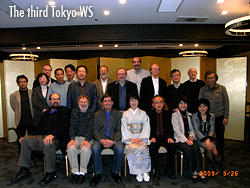 In March 25-27 of this year, we hosted The Third International Workshop on Emancipatory Pragmatics at Japan Women's University. On the first day, we focused on Libyan language and culture, and were honored to host inviting two cultural experts on Libyan culture. We also had extensive discussion on the freshly collected and transcribed Libyan Arabic discourse data. On the third day, we focused on the logic of ba. We were honored with the presence of Dr. Hiroshi Shimizu who pioneered the ba theory. Three participants came from the US, five came from Europe, one from Libya, and one from Korea. In March 25-27 of this year, we hosted The Third International Workshop on Emancipatory Pragmatics at Japan Women's University. On the first day, we focused on Libyan language and culture, and were honored to host inviting two cultural experts on Libyan culture. We also had extensive discussion on the freshly collected and transcribed Libyan Arabic discourse data. On the third day, we focused on the logic of ba. We were honored with the presence of Dr. Hiroshi Shimizu who pioneered the ba theory. Three participants came from the US, five came from Europe, one from Libya, and one from Korea.
All these activities are meant to be part of an effort to 'let the wind blow from multiple directions' as I stated in 2007 in my opening address as president of the 10th IPrA in Goethenberg, Sweden. Here is an excerpt from my speech:
After I was elected President last year, I visited the University of Antwerp, where the headquarters of this organization have been situated since its founding, and discussed with Jef what we could do during the coming six years of my presidency. As a result of the fact that the new president was selected from the non-European, non-American members, we thought some new directions for the studies of pragmatics might be in order. One such new direction would be to change the direction of the academic debate from unidirectional to multidirectional. What I mean by this is that modern scholarship in pragmatics has originated in the West and been disseminated all over the world, while little knowledge has been gleaned from other parts of the world. Even though we acknowledge the great academic contributions from the West, it might be time for us to learn from different areas of the world, areas that have their own traditions, in order to attain a better understanding of the complexity of practice of the human race.
I am looking forward to meeting and learning from you at Melbourne.
I am very happy to open this forum for you who are interested in pragmatics and IPrA in particular. This is intended to be a virtual meeting place where everyone can come and express their ideas on how we can advance the academic field of pragmatics.
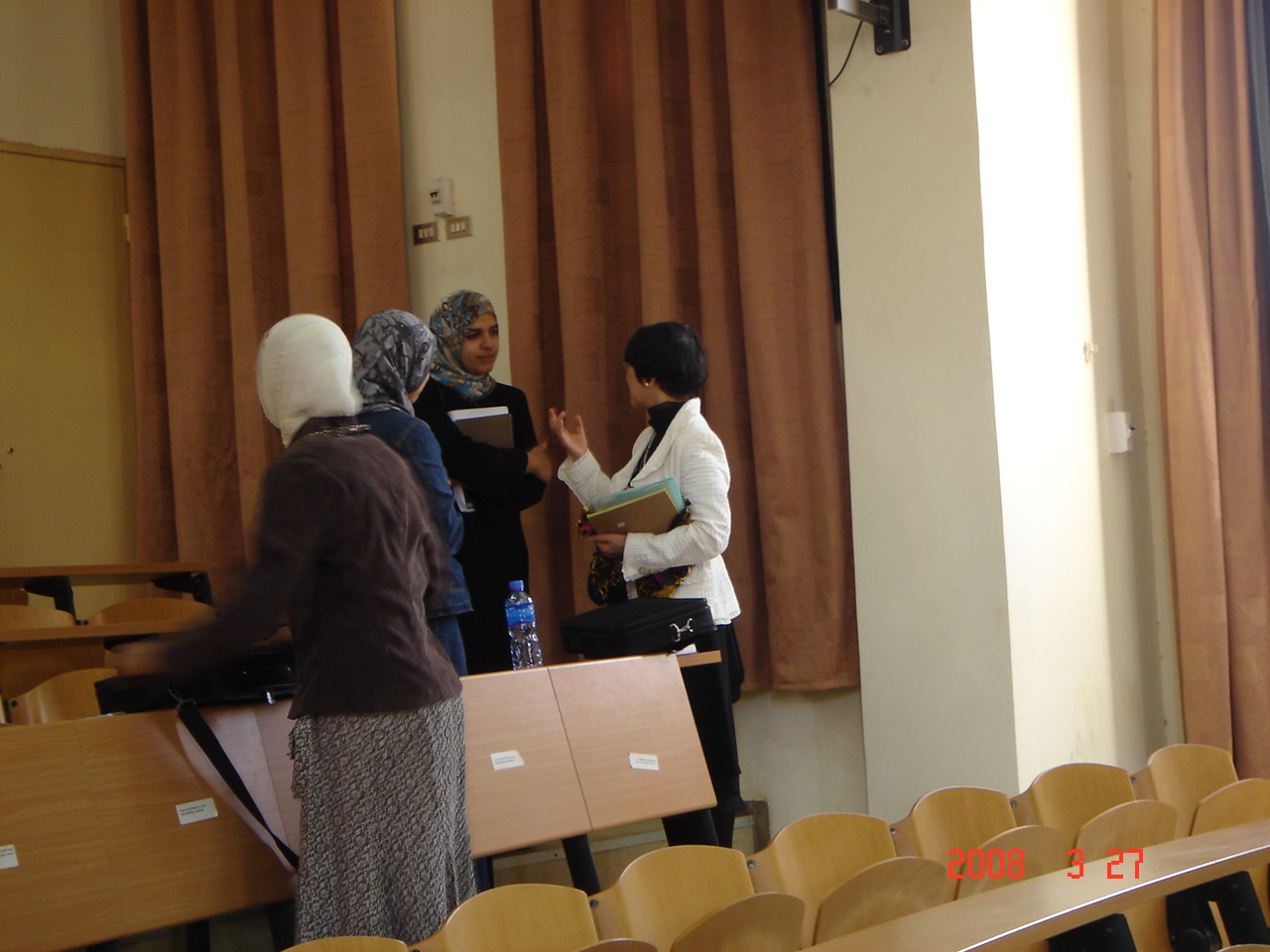
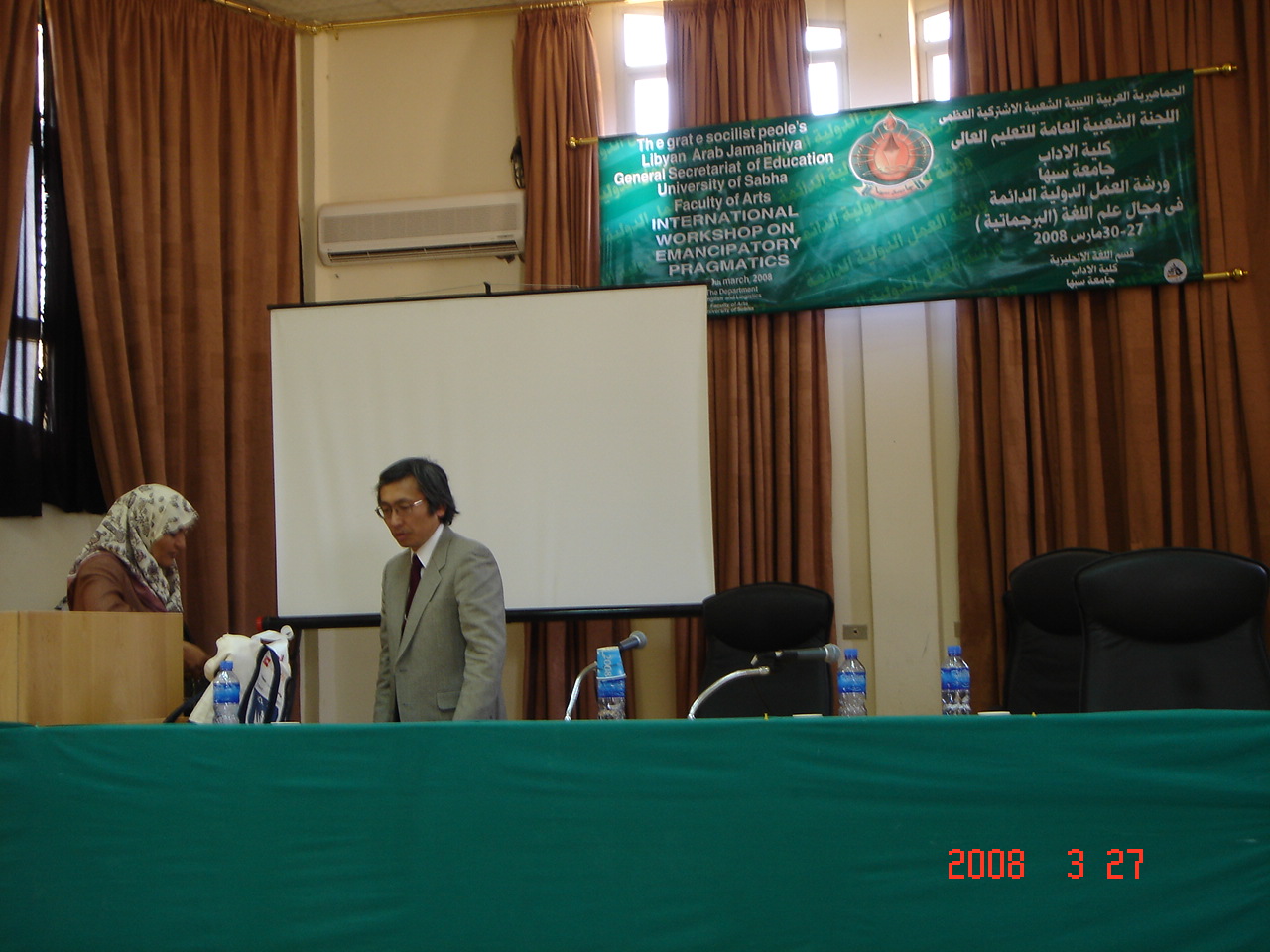
![IMG_0406[2][2].JPG](http://sachikoide.com/blog/images/IMG_0406[2][2]-thumb-200x150.jpg) While I welcome the academic wind from all directions, it has been my regret that little is known about the Islamic world. It had long been my dream to be able to visit one of the Islamic countries. In March, 2008, Dr. Mayouf and his colleagues of Sebha University at Sebha, Libya, held an International Workshop on Emancipatory Pragmatics. (Sebha is 800 kilometers south of Tripoli, the capital of Libya.) Three Japanese scholars (including myself) were invited to attend. While I welcome the academic wind from all directions, it has been my regret that little is known about the Islamic world. It had long been my dream to be able to visit one of the Islamic countries. In March, 2008, Dr. Mayouf and his colleagues of Sebha University at Sebha, Libya, held an International Workshop on Emancipatory Pragmatics. (Sebha is 800 kilometers south of Tripoli, the capital of Libya.) Three Japanese scholars (including myself) were invited to attend.
We had a great time exchanging ideas with colleagues and students at Sebha University. (Here are some pictures from that event.) What impressed me most was the comfort I felt throughout the duration of my stay. There was an air unspoiled by modernity in a physical and spiritual sense. 'Warm sun, warm people' made me feel freed of the hassles of the real world.
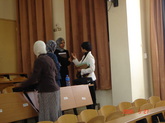 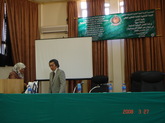 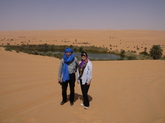
On the way back from Libya, I went to Amsterdam, where the Sociolinguistic Symposium 17 was held. I had a sort of cultural shock being back in a modern city. This was ironic, since I come from the modern city of Tokyo!
Dr. Li Wei of the University of London organized a workshop on 'Cultural Values and Language Behavior: Focus on Asia.' Four Japanese and four Thai presented papers on language use in these languages, and discussed the relevance of the cultural values behind discourse. This workshop must have appeared unique in a European oriented conference, as we dealt with the 'cultural values' observed in the languages and discourse. Dr. Li Wei, Dr. Krisadawan Hongladarom and I strongly feel the need for this kind of workshop to be continued until we reach the stage where everybody on this globe has a better understanding of different cultures and different peoples.
|
















![IMG_0406[2][2].JPG](http://sachikoide.com/blog/images/IMG_0406%5B2%5D%5B2%5D.JPG)